

 Single Faucet Kegerator Beer Dispensers
 Dual Faucet Two Tap Kegerators
 Triple Faucet Three Tap Kegerators
 Undercounter Built-In Kegerators
 Outdoor Kegerator Beer Dispensers
 ADA Kegerators
 Commercial Kegerators
 Mini Kegerators
 Cold Brew & Nitro Coffee Dispenser Kegerators
 Home Brew Kegerators
 Carbonated Water Kegerators
 15" Kegerators
 Kombucha Equipment
 Guinness® Dispensing Kegerators
 Wine Kegerators
 Kegerator Cabinets
 Kegerator Covers and Accessories
 Kegerators
 Kegerator Conversion Kits
 Kegs & Keg Accessories
 Beer Faucets
 Beer Shanks
 Draft Beer Towers
 Keg Taps Couplers
 Regulators & Gas Equipment
 Beer & Gas Line Hose
 Co2 and Nitrogen Air Tanks
 Beer Line Cleaning Equipment
 Drip Trays
 System Fittings
 Jockey Boxes
 Keg Beer Party Pumps
 Glassware
 Guinness® Dispensing Equipment
 Remote Glycol Systems
 Wine Cooler Refrigerators
 Wine Cellar Cabinets
 Wine Racks
 Cooling Units
 Wine Dispensing Systems
 Wine Accessories
 Wine Making
 Nitro Hot Draft System
 Ready to Drink Bag-in-a-Box Coffee Dispensing Equipment
 Nitrogen Infusers
 Nitrogen Tanks & Generators
 Nitrogen Beer Regulators
 Nitro Cold Brew Coffee Kegs
 Cold Brewed Coffee Tools
 Cleaning Equipment
 Outdoor Appliances
 ADA Appliances
 Panel Ready Appliances
 Commercial Grade Appliances
 Beverage Centers
 Refrigerators
 Drawer Refrigerators
 Ice Makers
 Water Dispensers & Accessories
 Freezers
 Home Brew Equipment Kits
 Fermentation Equipment
 Boiling and Mashing Equipment
 Home Brew Beer Kegs
 Home Brew Kegerator Conversion Kits
 Brewing Tools
 Home Brew Ingredients
 Cleaning Chemicals
 Test Equipment
 Home Brew Beer Bottles and Bottling Equipment
 Brewery Fittings
 Draft Beer Equipment
 Homebrewing Equipment
 Wine Equipment
 Luxury Appliances and Refrigeration
 Coffee Equipment
 Kombucha
 The Beverage Blog
 Frequently Asked Beer Questions
 Shop by Brand
 Shop by Category


January 08, 2020

Congratulations, you have your first kegerator and you're on your way to having crisp and cold draft beers on demand. Before you start enjoying the delicious taste of beer on tap, you'll need to set up an essential part of your kegerator, the CO2 gas system. Don't be intimidated by all the interior parts of a kegerator, they are meant to fit together perfectly and if you would like a deeper understanding of these parts, head to our Anatomy of a Kegerator blog to learn more.
We often get questions about setting up a gas system from new kegerator owners and we'd like to provide our professional tips on the best way to set up your CO2 system in order to get the perfect pour, as well as, how to find a leak and how to fix it.
How to set up a kegerator CO2 gas system
1. Make sure the regulator shut-off valve is closed.
2. Install the CO2 gas tube by attaching one end to the regulator and secure with the included clamps.
3. Make sure the clamps do not impede the shutoff valve.
4. Make sure the CO2 tank is shut off and closed.
5. Securely attach and tighten the regulator to the tank using a wrench, NOT pliers. Tighten the connection very well, this is a location that is prone to leaks, if not well secured.
6. Connect the keg coupler by pulling the handle back and attaching it to the top of the keg.
7. Turn clockwise about 25 degrees and use a wrench to secure it snug to the keg.
9. Attach the other end of the gas tube to the coupler's hose barb using the provided clamps.
10. To prevent leaks, ensure you have all your gaskets, beer fittings, and check valve is in place.
What causes a leak in a gas line?
The vinyl CO2 tubes are malleable when they're at room temperature but when they have been chilled inside a kegerator, they become rigid. Any movement of these rigid tubes can cause a leak to occur. We recommend that if you have moved anything in your kegerator system, to conduct a leak check because while your system may have been working perfectly fine, minor movements can cause a leak in the line.
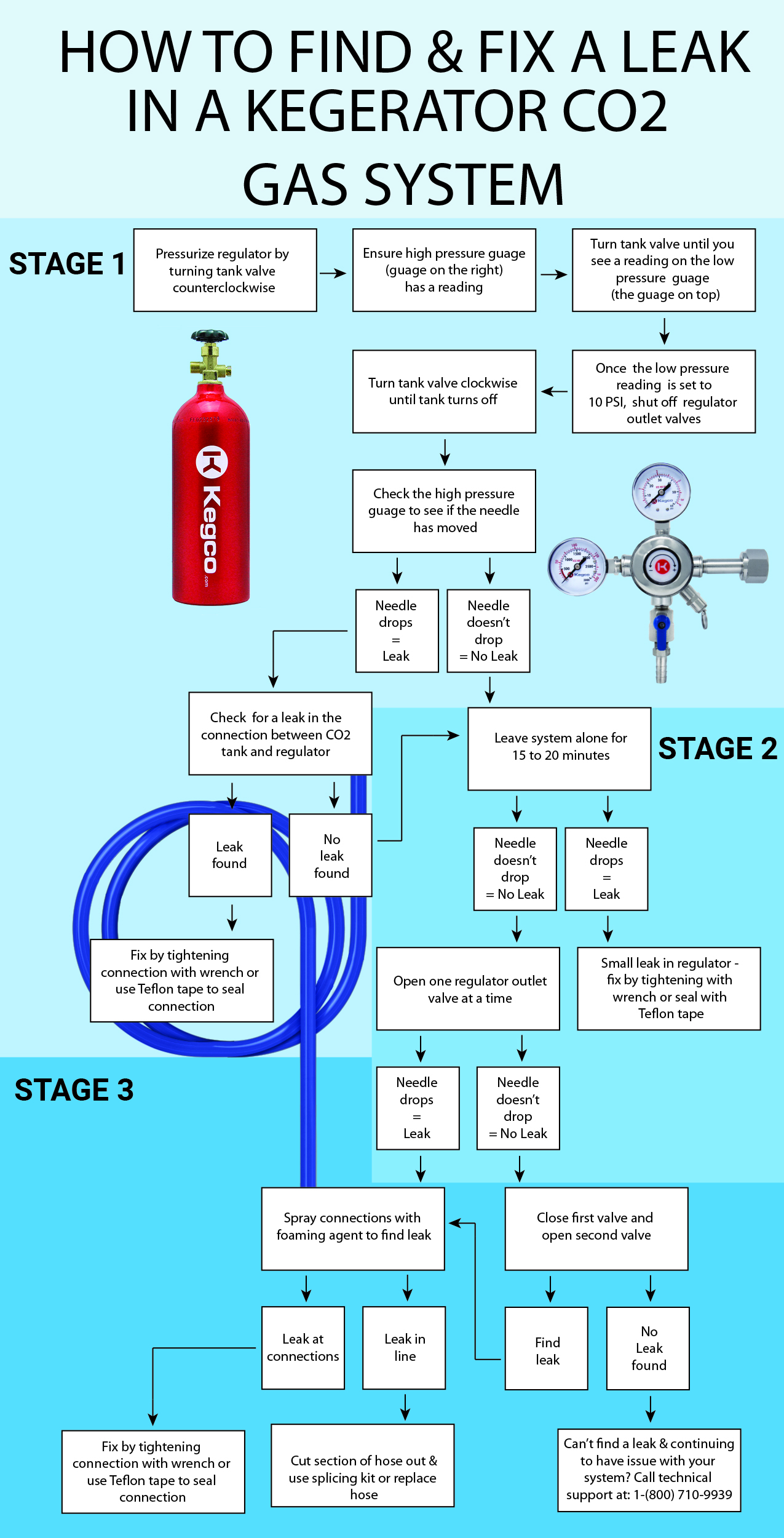
How to find a leak in a kegerator CO2 gas system
Quick Guide:
Steps:
1. Pressurize the regulator to isolate the leak by turning on the tank, by turning the valve counterclockwise.
2. Open the valve until you receive a reading. If the needle moves, this is a good indication that you are receiving a reading. You should be receiving a reading between 500 and 1,000 PSI, depending on the temperature of your tank, the ambient temperature, and altitude. If the needle moves, this is a good indication that you are receiving a reading.
3. Put pressure on the low-pressure side (this is the line that is pushing CO2 to your kegs) by turning the pressure adjustment handle on the regulator clockwise until you receive a reading of 10 PSI.
4. Once the regulator is set to 10 PSI, shut off the valves that send gas out of the regulator by turning them 90 degrees.
5. Turn your tank off by turning the valve clockwise.
6. Check your pressure gauge to see if the pin has moved at all.
- If it drops, you have a leak somewhere between the shut-off valves and the tank.
-First, check the connection between the CO2 tank and regulator. The most common place to find a leak is at this location. It can be easily fixed by tightening the connection with a specialty tank wrench or a large crescent wrench.
-If you have a leak in the regulator, it can be fixed with Teflon tape or tightening the connection with a wrench. Be sure to only use Teflon tape on a tapered or pipe thread (NPT) connection. It will fill in the gaps between the connection and prevent leakage.
-If the pin doesn't drop and your regulator is maintaining pressure, leave your gas system for 15 to 20 minutes and then come back to see if the pin has moved. This method will spot any small leak you may have in your system.
-If your pin drops, you may have a small leak in your regulator. Tighten the connection with a specialty tank wrench or a large crescent wrench.
-If your pin still doesn't drop, open up your regulator valves one at a time. If the pin drops after opening up the valve, you'll know that particular line or tube has a leak. Also, you will know that the leak is occurring between the shut-off valve and the keg.
7. Now that you know the general location of the leak, to find the precise location of the leak, you need to pressurize the line again by turning the CO2 tank back on.
8. Spray all the connections of the suspected leak zone, including threaded connections, hose connections, ball-lock connections, and all o-rings on the keg with a foaming agent.
9. When you spray the connections, if there is a leak, it will begin to foam rapidly to indicate a leak at that location.
-If the leak is at a connection, tighten the connection with a wrench.
-If the leak is on a hose, cut the damaged section out and use a splicing kit or replace it with a new CO2 hose.
-If the leak is at the coupler connection, tighten until snug. If the check valve in the coupler is damaged replace the coupler. In a pinch, you can use a neoprene washer in place of the check valve but you will run the risk of cycling beer back into your gas line.
10. If you don't see an indication of a leak but are still experiencing issues with your system, contact technical support at 1-(800) 710-9939 and our team will assist you.
Video:
How to fix a leak
If the leak is in the regulator...
Tighten the connection very well with a wrench or use Teflon tape to thoroughly seal the connection. Be sure to only use Teflon tape on a tapered or pipe thread (NPT) connection. It will fill in the gaps between the connection and prevent leakage.
If the leak is at the coupler connection...
Tighten the connection with a wrench until snug. If the check valve in the couple is damaged replace the coupler. In a pinch, you can use a neoprene washer in place of the check valve but you will run the risk of cycling beer back into your gas line.
If the leak is at another connection...
Tighten the connection with a wrench until snug.
Can't find a leak but still having issues with your kegerator system?
Contact our technical support for troubleshooting assistance at 1-(800) 710-9939.